
Guibé's Mantella

The Guibé's Mantella (Mantella nigricans) is a species of frog in the Mantellidae family. It is endemic to Madagascar. Its natural habitats are subtropical or tropical moist lowland forests and rivers. It is threatened by habitat loss.
It is a mildly toxic species, and is colored to advertise its toxicity. Unlike more toxic Mantellas, however, it is not particularly vivid. It is occasionally kept as a pet by herpetoculturists.
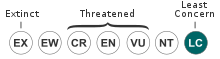
 Kingdom: Animalia
 Phylum: Chordata
 Class: Amphibia
 Order: Anura
 Family: Mantellidae
 Genus: Mantella
 Species: M. nigricans
 Binomial name
 Mantella nigricans
 Guibé, 1978

Geographic Range
This species occurs in northern and northeastern Madagascar from Tsaratanana south to Zahamena, at 100-1,240 m asl (Rakotomalala et al. 2001). It has also recently been confirmed from Betampona (Rosa et al. 2012).
Population
It is a locally abundant species. Due to ongoing decline in the extent and quality of habitat, the population is suspected to be decreasing.
Habitat and Ecology
It lives on the ground along streams in rainforest and forest edge, but not in severely degraded habitats. It presumably breeds like other species in the genus, with the eggs laid on land and larvae developing in streams.
Major Threat(s):
Its forest habitat is receding due to subsistence agriculture, timber extraction, charcoal manufacture, and invasive spread of eucalyptus, livestock grazing and expanding human settlements. It has so far only been traded internationally in very small numbers, but there could be greater demand in the future.
Species in this genus have tested positive for Batrachochytrium dendrobatidis (Bd), however currently there have been no negative effects observed within amphibian populations in Madagascar suggesting the Bd strain has a low virulence level (Bletz et al. 2015)